
- LazySEO is built from three parts: external links from a network of over 500 sites, content creation for your site, and Lazy Monitor for tracking rankings and competitors.
- The model is a monthly credit subscription. One link with an article = 5 credits. Credits reset at the end of the month and do not roll over.
- Links come only from sites in your niche or from general magazines with a matching category. The system blocks irrelevant placements.
According to a study by Princeton, Georgia Tech, and the Allen Institute (KDD 2024) that analyzed 10,000 queries, adding citations to content increased visibility in AI engine answers by 41%, and including statistics increased it by 32%. The same external authority that ranks in Google also increases the likelihood of being cited in ChatGPT and Claude.
LazySEO is an Israeli organic SEO platform that writes an article, publishes it on an external site from a network of over 500 sites, and places a link to your site in it, all in a fully automated end-to-end process. Alongside it runs a monitoring system called Lazy Monitor that shows what this activity actually produced. This guide explains exactly how it works, what it costs, and how to run it properly, including connecting Claude to run the entire process on its own.
In short
- LazySEO is built from three parts: external links from a network of over 500 sites, content creation for your site, and Lazy Monitor for tracking rankings and competitors.
- The model is a monthly credit subscription. One link with an article = 5 credits. Credits reset at the end of the month and do not roll over.
- Links come only from sites in your niche or from general magazines with a matching category. The system blocks irrelevant placements.
- A one-time setup of a client brain, then connecting an MCP to Claude Code that generates strategy, schedules, and publishes on its own.
- A reasonable pace for an established site: around 10 links per month, spread across different days.
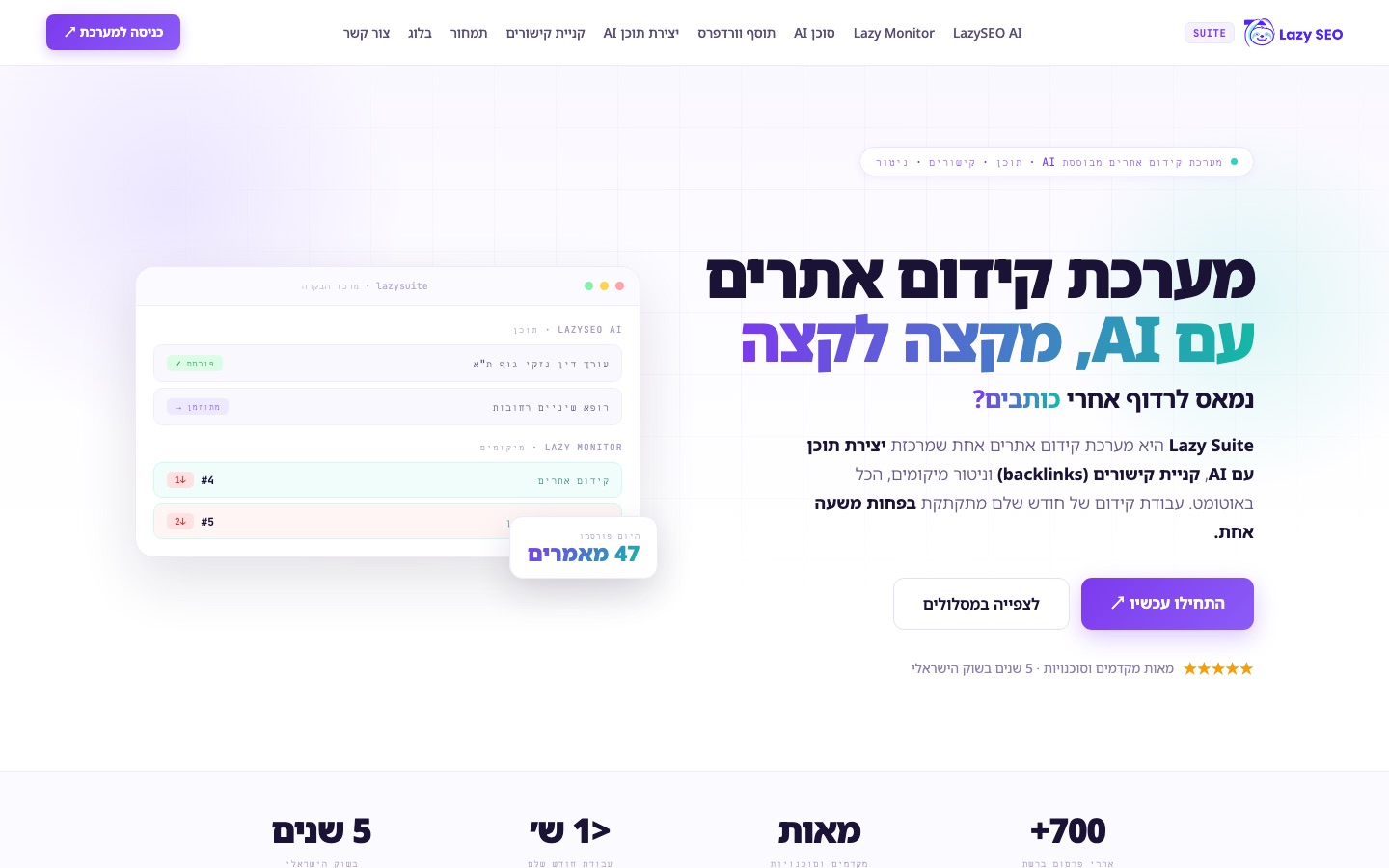 The official LazySEO website, photographed in September 2026. Credit: LazySEO
What exactly is LazySEO?
LazySEO is an Israeli organic SEO platform that writes an article, publishes it on an external site from a network of over 500 sites, and places a link to your site in it, all in a fully automated end-to-end process.
Instead of writing an article yourself, hunting for a host site, coordinating with the site owner, and paying separately, the entire chain happens inside a single interface. You create an article in the system, choose the sites you want to publish on, and the system takes care of the rest.
The platform has been operating in the Israeli market for over five years and is used by some of the country's largest SEO agencies, which run it on behalf of their clients.
Who is behind the platform: LazySEO was founded by Yaakov Tzedek, who won the Israeli website promoters competition in 2021, out of 150 advertising agencies. Since then, over one million links have been created through the system, along with data on what works and what does not in every niche.
Backlink: A link from another site to your site. Google treats it as a recommendation, an external signal that your site contains something worth pointing to. The more relevant and trustworthy the sources of those recommendations, the more weight they carry.
What does the platform include? Three parts
Three parts: an external link network, an engine for creating content on your site, and a monitoring system called Lazy Monitor. Each can be used independently.
1. External links
A network of over 500 sites, some built in-house and some from external providers. You create an article, choose sites for publication, and the system publishes it and returns the link to you.
2. Content creation for your site
The system can generate an article for your own site, including images and tables, and publish it directly to your site automatically. It works well with WordPress sites.
If your site is already built in Claude Code or in an environment you control, it is usually better to generate the content through Claude itself and use LazySEO primarily for links.
3. Lazy Monitor
The measurement layer: where you rank, which keywords are rising and which are falling, where you stand against competitors, and what questions people are asking in your space. This is the answer to the question "what did all this actually do."
How do the credit model and pricing work?
The subscription is monthly and renewing, and billing is by credits. One link, including the article written around it, costs 5 credits. A package of 15 credits is three links per month, at around 199 ILS.
| Package | Credits | Links per month | Monthly price | Cost per link |
|---|---|---|---|---|
| Starter | 15 | 3 | ~199 ILS | ~66 ILS |
| Extended | 50 | 10 | ~480 ILS | ~48 ILS |
These examples illustrate the structure. The current pricing appears on the packages page inside the system. For comparison: the exact same sites are sold elsewhere in the market at around 150 ILS per link. The difference comes from the operational model, not from a difference in site quality. The subscription comes with an invoice, so the cost, including VAT, is tax-deductible as a business expense.
⚠️ Important: credits reset. This is a monthly renewing subscription. Any unused credit does not carry over to the next month; it resets. So right at the start of each month it is worth building a publishing plan that spreads all the credits across the month and letting it run.
Where do the links come from?
From two groups only: sites in your niche, or general magazines that have a category matching your field. Irrelevant placements are blocked by the system.
The rule is simple: a link from a plumbing site to a tax-refund page creates no value because the context does not fit. The system will not allow publication on a site that has no connection to your field.
When selecting sites, do not look only at niche fit. Two additional parameters are worth attention:
- Age of the host domain: established magazines carry more weight than newer sites.
- Authority metrics (DR / DA): the scores displayed next to each site in the system help you prioritize.
A good combination is several niche-focused sites alongside established magazines with a matching category. That way the link profile looks more varied and natural.
Is a link from a site with no traffic worth anything?
Yes, provided it is part of a broader picture. Google looks for signals that indicate your site is credible and active. When those signals are in place, even lower-cost links contribute authority.
What counts as a signal? An active Facebook page linking to the site, a blog that is regularly updated, new articles, useful tools inside the site, diverse inbound references from different directions. All of these tell Google it is dealing with a live business, not a site whose only purpose is to absorb links.
Once that picture is in place, a measured volume of links adds to it. Without that picture, links alone work less effectively.
Why is the price lower than the market rate?
Because of a volume model. Instead of a site owner selling ten links a month through manual coordination, they are connected to a plugin that sells hundreds of links through it automatically, earning more even at a lower per-unit price.
The traditional process is expensive because it is manual: back-and-forth with the site owner, sending the article, waiting, approval, publication. Every one of those steps costs time, and that time is baked into the price.
LazySEO approached site owners with a different proposition: a plugin that does everything automatically, with no human touch. The result is lower costs for the end client and less workload for the site owner, while at the same time more revenue for the site owner thanks to volume.
How many links should you build per month, and how should you spread them?
For an established site of around three to four years old, about 10 links per month is a reasonable pace. More important than the number: spread them across the month on varying days, with no fixed pattern.
| Domain age | Recommended monthly pace | Note |
|---|---|---|
| New site (up to one year) | 3, 5 | Start low and build a content foundation in parallel |
| One to three years | 5, 8 | Gradual increase, no sudden jumps |
| Three years and above | 10 | Spread 2 / 2 / 3 / 3 across the month |
The common mistake is a fixed schedule, for example every Sunday and every Thursday. A repeating pattern looks mechanical; a varied spread looks like natural business activity. This scheduling can be handed to Claude via the MCP so it builds the calendar on its own each month.
What is an anchor and how do you build the right distribution?
An anchor is the text that carries the link, usually the keyword you are targeting. The rule: do not put all your links on the same word. Distribute them across different phrases.
Anchor text: The visible text that is clicked to reach your site. If the target page is "tax refunds," one anchor can be "tax refunds," another "capital gains tax," and a third the brand name. Google learns from the anchor what the page is about.
| Anchor type | Example | Share of the mix |
|---|---|---|
| Exact match | tax refunds | 2 |
| Variations of the phrase | tax refund for employees | 3 |
| Related terms | capital gains tax, bookkeeping | 3 |
| Brand name or URL | firm name | 2 |
You can ask Claude, through the MCP, to build the full anchor mix for a whole month and assign each anchor to the appropriate target page. The system generates a different article for each link, even when the topic is the same. Content does not repeat.
What is the client brain and why is it set up only once?
The client brain is a profile the system builds for your business from your site's URL. After a one-time setup, every article created speaks in your language, in your context, and weaves the link in on its own.
In practice: you go in once, enter the main site URL, and the system identifies the field of business, keywords, writing style, and internal links. From that point on it knows how to frame the general problem in your space and then connect it to you. This is the only setup step that requires real attention. After that, the process runs.
How do you connect MCP to Claude and what does it give you?
An MCP connection lets Claude read the site list and data inside the system, build a strategy, schedule, and publish, without you touching the interface.
MCP: A protocol that connects a language model to an external system so the model can read data from it and perform actions in it. In this case: Claude gets direct access to the site list, your package, and the publishing actions in LazySEO.
- Purchase a subscription and choose a package based on the monthly link volume you want.
- Set up the client brain once, using the main site URL.
- Connect the MCP to Claude Code, where you can also build functions and recurring schedules.
- Define the rules: this is the package, this is the pace, these are the target pages, use all the credits by the end of the month.
- Request ongoing updates: a monthly or weekly summary of what was published, where, and with which anchor.
Because the system has been operating for over five years and has accumulated data from over one million links across many niches, it also feeds Claude what works and what does not in your niche. You can add the Lazy Monitor API to the picture as well. Then Claude has both execution and measurement: it sees what it did and what came of it, and can adjust accordingly.
Tip, WhatsApp updates: You can connect Claude to green-API so it sends summaries and updates directly to your WhatsApp: what was published, where, and with which anchor. Instead of logging in to check, the report comes to you.
Weekly audit: A habit that pays off. Once a week, ask Claude to run an audit of the site: what improved, what stalled, what should change. This complements the activity and keeps the plan current.
Want a bot to prepare this work for you and stop for approval before every publication? I wrote about how to manage link-building work with a bot in Grok Bot.
What do you do after the link goes live?
You distribute it. Sharing the published article on your business page, personal profile, Instagram, and LinkedIn generates traffic and mentions around that link, exactly as it would with a real editorial piece.
The logic is simple: if a magazine had genuinely published a feature about you, you would share it. That sharing turns the link from a standalone item into an event with activity around it:
- Business Facebook page: "A new article about us was just published in..."
- Personal profile: the same piece, written in a personal tone
- LinkedIn: especially relevant in business and professional fields
- Instagram: a Story with the link
How do you check whether the link is indexed?
Search Google using the site: command followed by the URL of the page where the link was published. If the page appears, it is indexed. If it does not, the link has no effect.
site:https://example.co.il/article-page/
This is a check worth running on every link you buy, from any vendor. A page that is not in Google's index does not exist as far as Google is concerned, so the link inside it is worth nothing. If a page is not indexed, it happens. Contact the vendor you purchased the link from and ask them to get it indexed. It is a legitimate and routine request.
Can Google penalize you for links like these?
At the pace and volume described here, the risk is low. Penalties typically come from extreme patterns, such as a sudden one-time flood of tens of thousands of links from irrelevant foreign sites.
Ten links per month, in a relevant niche, spread across the month, with a sensible anchor distribution, is not the behavior Google targets when it deals with spam. The guiding rule is simple: never do anything at a scale a real person would not do.
What is Lazy Monitor?
A separate monitoring system that shows what is actually happening: real-time rankings, which keywords are rising and falling, your position relative to competitors, and questions people are asking in your space. Base cost: approximately 69 ILS per month.
- Rank tracking: what went up, what went down, and when
- Competitors: where you stand against them and what they rank for
- Link monitoring: daily tracking of link status
- Content topics: real questions your audience is asking, a solid foundation for future articles
- White-label reports: for agencies that report to clients
The core value is in the connection: when both LazySEO and Lazy Monitor are connected to Claude, it has both hands to act and eyes to see the results.
What LazySEO does not do, and mistakes worth avoiding
LazySEO handles external signals and content. It does not replace a full SEO strategy, and it does not provide premium links from major publications. Those are a separate service.
Premium links: Publication in leading financial magazines (such as TheMarker or Globes) or in mainstream media outlets is not part of the subscription. That is a separate service, and in most cases there is no need for it on a regular basis. Once every six months is more than enough to strengthen a backlink profile.
Local pages, an opportunity most people miss: If the goal is leads relatively quickly, build local pages for your services: "land appreciation tax refund in Ramat Gan," "accountant in Rishon LeZion." Lower competition, higher purchase intent.
Keep page types separate: Do not target the same exact phrase with both an article and a service page. That creates cannibalization, where your two pages compete against each other for the same query and neither one stabilizes. Money pages get the core keywords, articles get the broader terms and questions.
How does this connect to AI-based search?
External authority also influences answer engines. AI engines pull sources and cite them, and a site with established authority and structured content is significantly more likely to be surfaced.
- According to research by Princeton University, Georgia Tech, the Allen Institute, and IIT Delhi (KDD 2024), which examined 10,000 queries: incorporating citations increased visibility in AI answers by 41%, statistics by 32%, and source references by 30%.
- According to data from Brandlight, the overlap between top Google results and the sources cited in AI answers has dropped from roughly 70% to under 20%. A high Google ranking no longer guarantees appearance in AI answers.
- According to Gartner (February 2024), traditional search volume is expected to decline by approximately 25% by 2026.
- According to Seer Interactive, the conversion rate of visitors arriving from AI engines is significantly higher than that of regular organic traffic. Smaller in volume, but higher in quality.
The practical conclusion: links and structured content work in both directions. The same activity that builds authority in Google also increases the likelihood of being cited in AI answers. That is exactly the logic behind GEO, Generative Engine Optimization, and why it makes sense to build both layers in parallel.
The bottom line
LazySEO takes the most manual and expensive part of SEO, content production and link building, and turns it into a credit-based automated process that you can run entirely through Claude. My recommendation: open a subscription, set up a client brain once, connect the MCP, and from there the process runs on its own. Want to learn how to build automations like this yourself? There is a Claude Code course and AI consulting for businesses.
Frequently asked questions

Yaakov Tzedek
An Israeli AI lecturer, consultant and implementer who has supported 100+ organizations in AI implementation and lectured for 200+. Official content partner of Meta, Google, Canva and TikTok, featured on Israel's Channel 13.
More about Yaakov →