- Deciding between an AI workshop and an AI lecture for your organization? The differences in outcomes, cost, and preparation, plus a combined track most organizations discover too late.
Organizations that start with an inspirational lecture and follow it with a hands-on workshop within a month report significantly higher tool adoption compared to organizations that did only one or the other. The lecture opens minds; the workshop builds habits.
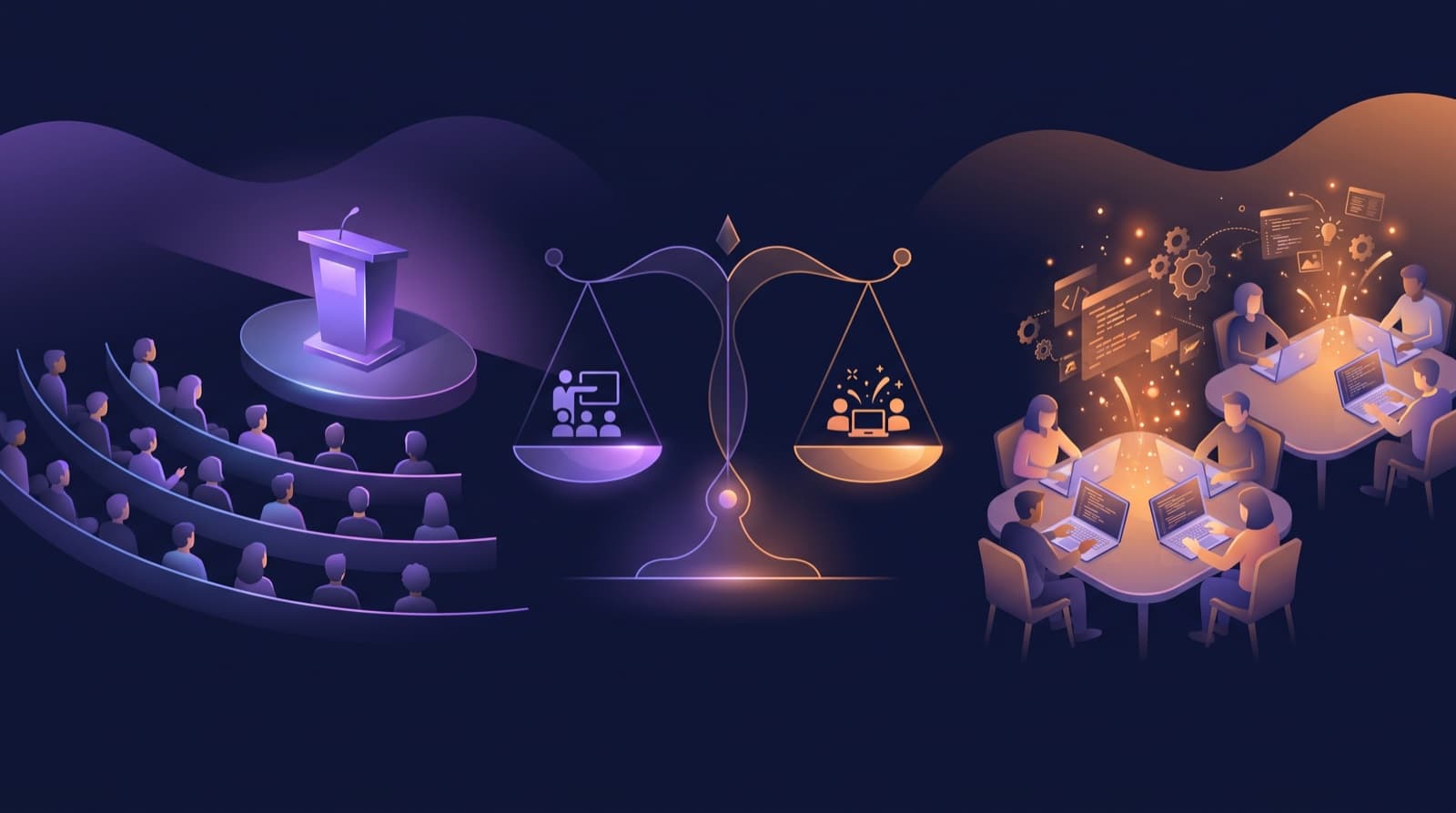
Torn between an AI lecture and an AI workshop? The short answer: a lecture changes what people think; a workshop changes what they do. A lecture works for broad alignment and opening minds; a workshop is for when you want people to walk back to their desks with a tool that actually works. This guide breaks down the differences in outcomes, pricing, and logistics, and shows you when it makes sense to combine both.
In short: the decision table
| Criterion | AI Lecture | Hands-on AI Workshop |
|---|---|---|
| Duration | 1-2 hours | 2 hours to a full day |
| Audience size | No practical limit | Up to 25 participants per facilitator |
| What participants do | Listen, ask questions, watch demos | Work independently on a computer |
| What stays afterward | Motivation, shared language, direction | A working deliverable: a prompt, an automation, or an agent |
| Logistics required | Hall or Zoom, projector | A laptop for every participant, accounts for the tools |
| Best for | All employees, management, conferences | Teams that will actually implement |
What is an AI lecture and what does it actually deliver?
An AI lecture is a one-time session in which an expert shows an audience what today's tools can do, demonstrates scenarios relevant to the organization's field, and answers questions. Its power is breadth: in a single hour you can reach a hundred employees, establish a shared vocabulary, and defuse the anxiety of "it's going to replace me."
Its weakness is well known in advance: nobody acquires a skill by watching. A week after an excellent lecture, most participants remember the feeling and forget the steps. That is why AI lectures for organizations work best as the opening move of a larger initiative, not as the initiative itself.
What is a hands-on AI workshop and why does it work differently?
In a hands-on AI workshop every participant sits in front of a computer and works on their own: drafting prompts for real tasks from their actual job, building a first automation or a first agent, and getting close guidance when they get stuck. The knowledge enters through the hands, so it stays.
That is precisely what sets an AI workshop for organizations apart from watching yet another training video: by the end of the session, every participant has a deliverable they built themselves that works on a real task of theirs. Anyone who wants to see what that kind of day looks like hour by hour will find a full sample agenda in the separate guide.
When should you choose a lecture?
A lecture is the right choice in three situations:
- Broad alignment. When you need everyone in the organization, from the CEO to a new hire, to understand what AI is changing in your field and what the policy is. Large audience, consistent message, a single cost.
- An event or conference. Study days, all-hands events, and team-building days, where the goal is inspiration and direction rather than practice.
- An exploratory phase. When management has not yet decided how much to invest, a lecture is a relatively low-cost way to gauge interest before committing to a full training program.
If your audience is spread out, like a professional community, an alumni network, or an organization with multiple branches, we have put together a separate guide on an AI webinar for a professional community or organization: choosing a topic, structuring the session, running interaction on Zoom, and measuring results.
When should you choose a workshop?
A workshop is the right choice when there is a genuine intention to implement:
- A team with defined tasks. A marketing department that wants to shorten content creation, a customer service team that wants faster responses, a finance team that wants to automate reports. The more specific the task, the more immediate the result.
- After a lecture that sparked interest. The critical window is up to one month: that is the time to convert motivation into habit through a hands-on AI workshop for the relevant teams.
- Rolling out a new tool. When the organization has adopted Copilot, Claude, or Gemini and employees are using a fraction of the capabilities.
The combined path: what most organizations discover too late
The choice between a lecture and a workshop is usually a question of sequence, not preference. The path we have seen work again and again across hundreds of organizations:
- An opening lecture for all employees (1 to 1.5 hours): aligning vocabulary, addressing concerns, demos from the organization's own field.
- A hands-on workshop for the leading teams (half a day to a full day, within one month of the lecture): each team builds one real process of their own.
- A follow-up session two to three weeks later: solving blockers that surfaced in practice and turning a first attempt into routine.
Organizations that skip step 1 get a workshop where some participants arrive skeptical. Organizations that stop after step 1 get enthusiasm that evaporates within two weeks. The combination is what produces lasting change, and it is also the foundation for a broader AI implementation program.
What about the price?
A lecture costs less as a standalone event, but the right comparison is cost versus outcome: a lecture buys awareness; a workshop buys capability. Full price ranges for both formats, including what affects the price and what is included in a proposal, are covered in the guide how much does an AI workshop for employees cost and in the broader guide on AI training costs by format.
One tip for real savings: if you are planning both a lecture and a workshop, close them as a single package with the same facilitator. The price comes down, and the workshop is built on the language and examples the lecture already established.
How do you choose the right facilitator, for either format?
Three questions that filter quickly:
- Does the facilitator implement AI themselves? Someone who only lectures about AI is speaking from summaries. Someone who builds systems and works with organizations is speaking from experience, including the mistakes.
- Is the content tailored to your field? Ask to see an agenda with examples from your world, not a generic slide deck.
- What happens after the session? Materials, recordings, a channel for follow-up questions. Without those, even an excellent session fades.
The full checklist, including a ready-made RFQ template for procurement, is in the guide how to choose an AI training provider.
Frequently asked questions
What is the main difference between an AI workshop and an AI lecture? A lecture is a viewing and inspiration session for a large audience. A workshop is a working session in which every participant practices on their own and leaves with a working deliverable.
What is better for an organization just starting out? A lecture for broad alignment, and within a month a hands-on workshop for the teams doing the implementing. Either one alone leaves the job half done.
Can a workshop be run on Zoom? Yes. A Zoom workshop with breakout rooms works well for small groups and saves logistics costs. For larger groups, the in-person format still wins on the quality of individual guidance.
How far in advance do you need to book? A lecture can be booked as little as two weeks out. A tailored workshop requires a scoping call and scenario preparation, so a month in advance is a comfortable timeline.
The bottom line
Do not ask "lecture or workshop." Ask "what do we want to happen the day after." If the answer is "we want people to understand and feel energized," that is a lecture. If the answer is "we want people to work differently," that is a workshop. And if you are serious about both, the combined path delivers both for less money than it sounds.
Want to find out what fits your organization? Talk to us and we will come back to you with a tailored format recommendation, no commitment required.
Frequently asked questions

Yaakov Tzedek
An Israeli AI lecturer, consultant and implementer who has supported 100+ organizations in AI implementation and lectured for 200+. Official content partner of Meta, Google, Canva and TikTok, featured on Israel's Channel 13.
More about Yaakov →